Tuesday, February 7, 2012

Book Review- The Widsom of the Radish by Lynda Hopkins

I recently picked up a copy of The Wisdom of the Radish from my local library. I just happened upon it- I was browsing through the gardening books and just as Mike asked haven't you read them all already?, I found it. I've been really enjoying these small farm non-fiction books since I've stumbled upon several of them.

I really appreciate that:
a) the authors are my age
b) a lot of them are coming from a similar background to myself aka no farming experience
c) the narratives are a lot of fun to read- It's nice to feel like you're experencing the story right along with the authors.

The Wisdom of the Radish was well written, well organized, and thoughtfully constructed. Lynda, who is the author, writes of the experiences she and her boyfriend  (now husband) Emmett go through starting their own farm, selling at markets, trying their hand at animal husbandry, and other farm-based activites. Lynda and Emmett go through a lot of trials and mistakes during the first year on their farm, and if you're a gardener or  have ever taken on a project that you didn't fully understand the scope of, you'll identify a lot with the author as you read this book. It has a nice blend of humor, serious and heart-wrenching stories, and farm lessons learned along the way.

If you're looking for a fairly easy farm read, pick up a copy of The Wisdom of the Radish- it'll do the trick!

Monday, February 6, 2012

Tackling those lingering home projects

I'm a busy person by nature- I liked to keep occupied. My weekends are usually filled with a combination of reading about projects, dreaming about projects, failed attempts at projects, and successful attempts at projects, in frequency of that order. This weekend, however, was a ACTION weekend: many long-dreamed projects were finished!

handmade spice rack! Turned out so well.
Project #1 Spice Rack
There are two tutorial posts on making this if you're interested, so I'll keep it brief, but at our house we probably have close to 100 spice jars. They needed a more permanent home, and with help from my dad, my roommate, and my husband, an amazingly awesome spice rack was achieved! It will not fly off the wall, it is secure, and it looks pretty damn sweet.

I was so high on the feeling of accomplishment that I made a second, smaller spice rack for above the stove- haha!
so awesome, right?
Project #2-Under-cabinet trash can
We don't produce a lot of trash around here. As a house of 3 people, we only produce about 1-1.5 trash bags per week, which is pretty good. We also do a fair amount of recycling & re-purposing. The current method we use for recycling is piling it up on the kitchen counter by the sink, which is cluttery and drives me crazy! I decided to install a pull-out cabinet shelves, with a trash can attached! I got it from Home Depot, where I would rather not shop, but I'm not a frequent customer there. Sometimes you cave when ya don't want to..

I'm a big fan of it so far, and I'm thinking about using this as our trashcan (it's 20 qts), and using our 35 qt current trash can as an indoor recycling bin. We'll try it for a week and see how it goes- having a smaller can for actual trash might help us reduce our consumption even more. Ideally, we'd be consuming less, and would be producing a lot less trash overall. Recycling is a good first step, but re-purposing and reusing is really better.


less junky Junk Drawer


Project #3- Junk Drawer organizing
My kitchen cabinet drawers always get really junked up, and it becomes so packed that I can't even open the drawer. In the middle of this project frenzy, I spyed some empty berry containers, and decided to re-purpose them.

I stacked them up against each, and added another basket. Then I took every thing out of drawer, sorted it, and then put things back into the smaller baskets. Things are organized by function now, and it feels good! No more jammed up drawer.


Seedlings!


Project #4- Seed Starting!
Today, I started my first seeds of the 2012 growing season!! To be more specific, my roommate and I started them together; Thai Basil, Lemon Basil, Cilantro, Sage, Cumin, and Spearmint. Also started some Copra and Valenica onions, as well as Speckles lettuce.

I plan to keep the herbs indoors for a while to use in the kitchen and suppliment my current flock, and eventually the onions and lettuce will be transplated outdoors to my garden.

We're in the home strech, my friends- only 15 weeks until Southeastern Michian's Frost Free date- May 16th!

What home projects have you been eyeing recently?

Saturday, February 4, 2012

Make your own Spice Rack (pt 2)

This is a continuation, so if you didn't catch the first part, check it out here.
Now that you have your materials, you might need to cut them to size. If you've gotten your boards from a hardware store, they will probably cut them for you for free. Once you've got 'em cut, bring 'em home- they're ready to assemble!

First, you need to make marks where your screws will go to attach the board to the shelves. For each shelf, start 3 inches in on the back board, and space your holes out (I used a spacing of 8 inches between screws). Mark where the holes should be on the board with a pencil, and then drill straight through the back board.  I used a 1/8ths bit.
Once you've got your basic holes laid out, you can use a counter sink bit. This allows you to drill right over your existing hole on the back board, and drill a conical hole. The benefit of this is that the top of your screw will be flush with the board, and when you paint the final coat, you won't be able to see the screws, or at least they won't be as noticeable (see the pic below for a before countersink picture)

Drill your woodscrews through the countersink holes, through the back board and into the shelves, one by one. I like to start by partially screwing in one screw on the left side, partially screwing in the middle screw, then partially screwing in the end screw; this way I can make small adjustments and I make sure everything is equally tight across the board (haha!).

Now you should have a flat back board with two shelves attached to it!

mollie, screw, and the red piece
Next steps are easy:

  • Paint it!
  • Paint another coat on it!
  • Let it dry for 6-10 hours (this is the hardest part for me!)
Last step is to measure out your last set of holes- the ones that will screw the hole spice rack into the wall. To do this, lay your spice rack on the table, face up (shelf side up). Take that pencil you had earlier, and mark out where your screws will go- again I'd go with starting 3 inches in and spacing every 8 inches, but it depends on what sized rack you're making.

Once you've marked out the holes on the board, carefully and accurately mark them on the wall as well. Take your drill, put on a 5/64ths bit, and drill your wall holes. These holes will be bigger than those you drilled for the shelves- these holes are for the mollies.

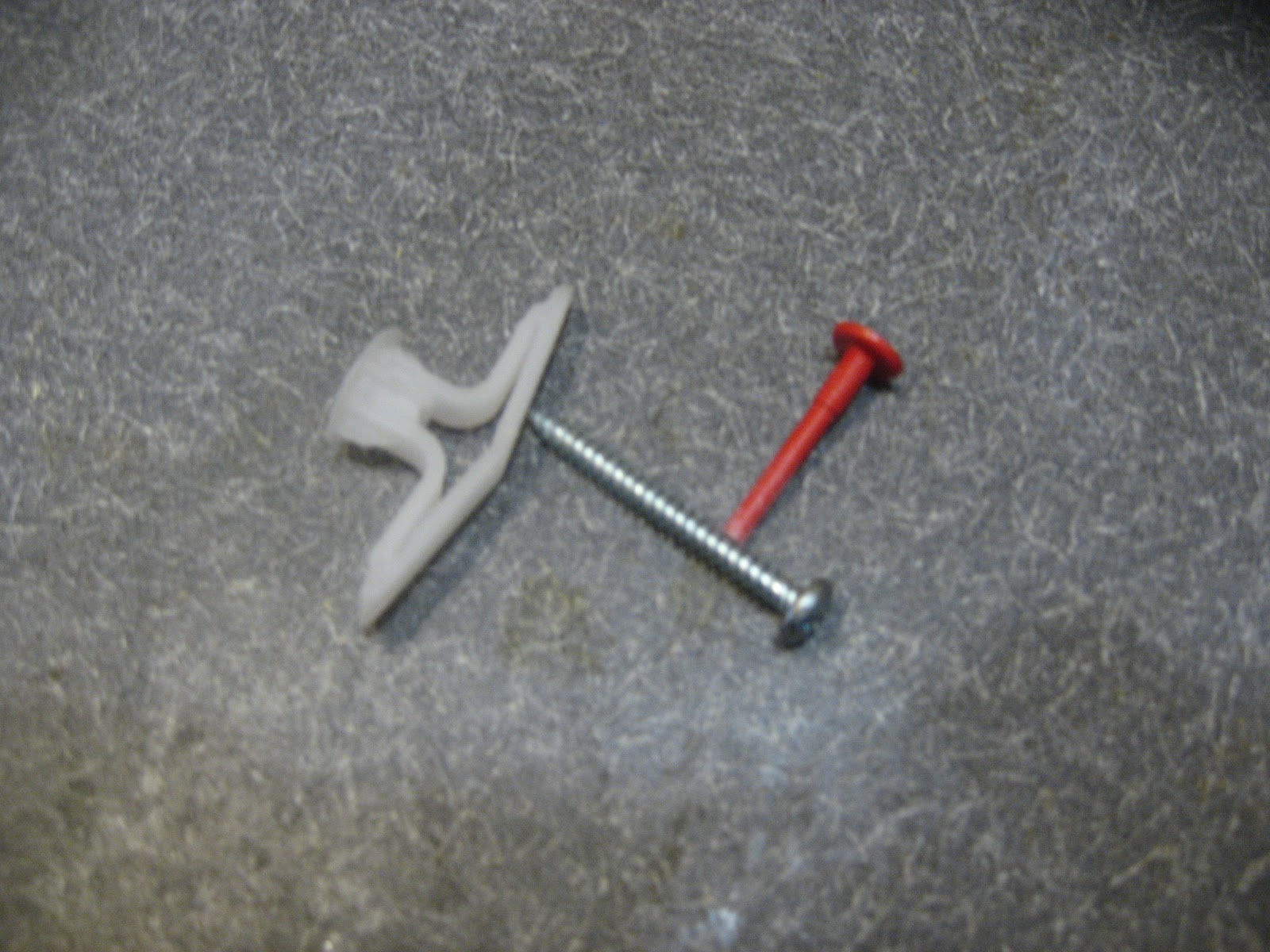
Pinch the mollies and position them over the holes you've drilled, then tap them in withe a hammer. Once they're as flat to the wall as they can be, take the red piece, and put it into the hole on the mollie. You're pushing until the back of the mollie pops out into the wall. 

Now drill holes into your board with the 1/8ths inch bit, like you did for the shelves. You'll be drilling into the front this time. When you're done with those, you'll want to use the countersink (if you have one) to make those holes a better, conical shape.

You're ready now to drill the screws through the backboard and into the wall (through the mollies). Make sure your board is lined up with the mollie holes correctly- this is a point where you might want a friend to help you hold the shelf up in place.

If you did it right, a) your spice rack should be attached securely to the wall and b) you should have screwed the screws in really tight, and when you run your hand across the board where the screws are, they won't protrude higher than the board! If this is the case, you can use some wood putty and caulk over the holes. Let that dry, then you can paint over the caulking, and you'll have a nice, finished looking product!

If you were like me, and your countersinking didn't get your screws at flat to the wall as you wanted- it's still ok- I'd recommed just painting over the screws, one or two coats. In the long run, you still have a nice spice rack with disgued, incognito screws. Go ahead and put those spice on there!

                                                                          Nice Rack!

Wednesday, February 1, 2012

Dark Days Challenge Week 8- Creamy Polenta

Polenta is easy to make, friends. Damn easy. I promise! Once you make it, it will seem silly to buy one of those pre-made polenta rolls from the grocery store. Polenta is quick to make, it's good, and it's a great host to veggies, meats, and lots of yummy toppings!

Week 8

Creamy Polenta
Ingredients: 
1/2 cup yellow cornmeal
source: West Wind Milling Co, 50 mile radius
1 tbsp salt
source: not local
2 cups water
source: tap water, ya'll!
2 tbsp butter
source: Calder Dairy, 50 mile radius

Cornmeal for polenta
Directions:
  • Get out a deep skillet or frying pan! 
  • Add the 2 cups water, and set to a boil
  • Once water is boiling, add the salt, then add the cornmeal
  • Stir, and bring heat down to low
  • Cook until mixture thickens and cornmeal is tender 
  • Turn off the heat, and add butter. 
  • Stir until butter is incorporated, and add thyme, oregano, rosemary, chives, etc. as desired


                                                    It's that easy. Plate, serve, and Enjoy!

Polenta topped with roasted root veggies